
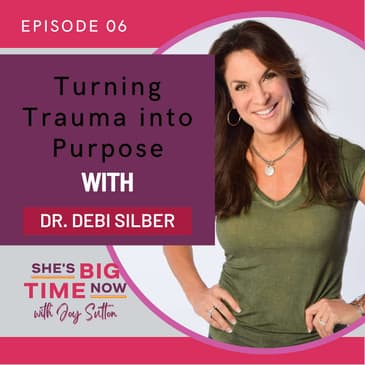
Dr. Debi Silber, a holistic psychologist, turned the pain from two betrayals from her family into her purpose. It was through her own healing that she discovered a unique process for dealing with betrayal. Her groundbreaking research has been featured on Fox, CBS, Dr. Oz, and twice as a TedX speaker. Her personal journey also led Dr. Debi to open an institute to help others, called the Post Betrayal Transformation Institute, a first of its kind, in the space for helping people to heal from the physical, mental and emotional trauma of betrayal. She's also the author of six books and the host of the podcast From Betrayal to Breakthrough. On the show, she shares how pain can be a catalyst for purpose, how she turned her personal journey into a business, and the ground breaking discovery she made about betrayal. In this episode you’ll learn:
- What Dr. Debi feels is the key to her success
- How she knew she wanted to help others with betrayal trauma
- How a mastermind group was essential for her business growth
- How your trauma can become something profound
- How Dr. Debi pivoted into helping others with betrayal trauma
- What keeps Dr. Debi going in her work
- Her advice for aspiring entrepreneurs
- What to do if you feel like giving up
- The best advice Dr. Debi has ever received
Connect with Dr. Debi
https://thepbtinstitute.com/
https://www.instagram.com/debisilber
Connect with Joy:
https://www.instagram.com/joysuttonmedia
https://www.facebook.com/joysuttonmedia
https://www.linkedin.com/in/joy-sutton-671b0953
To book Joy for your event visit www.thejoysutton.com
[00:00:00] Hello and welcome to Shes Big Time Now, a podcast for women who are refusing to play small. My guest today is Dr. Debi Silber, a holistic psychologist who turned the pain from two patrials from her family into her Purpose. It was through her own healing that she discovered
[00:00:20] a unique process for dealing with betrayal, her groundbreaking research has been featured on Fox, CBS Dr. Oz and twice as a TEDx speaker. Her personal journey also led Dr. Debi to open an institute to help others, called the Post-Betraille Transformation Institute of First of Its
[00:00:42] Kind, offering a space for people to heal from physical, mental, and emotional trauma caused by a betrayal. She's also the author of six books and the host of the podcast from betrayal to breakthrough.
[00:00:57] On the show, she shares how pain can be a capitalist for Purpose. How she turned her personal journey into a business and the groundbreaking discovery she made about betrayal. Let's get into the show.
[00:01:36] Well, I'm so excited today to have another special guest, Dr. Debi, as she likes to be called, she is a pioneer in what she has done as you've just heard from her intro and I'm really excited to
[00:01:47] dig into your story, Dr. Debi. Thank you for joining us on the podcast. Oh, happy to be here looking for a entire conversation. Well, one of the questions that I first like to ask people because this is really about women who are
[00:02:01] refusing to play small and are going big time, what do you feel is the reason or the key to your success? And why you've been able to make it big in the industry that you're in? You know, really all I've
[00:02:15] done is do something really good with something really painful. You know, one studies betrayal, unless you have to. Let's face it. It's my 30th year in business and his life would sort of
[00:02:26] worth and change so in business. And I was in health and then mindset and then personal development. And then I had a really painful betrayal from my family. Thought I did everything I needed to do
[00:02:37] to help from that and then it happened a few years later. This time, it was my husband. Anybody who's been through it, your blindsided, your devastated. And a book wasn't going to get me out of this
[00:02:47] jam like I needed more than that. So here it was, you know, four kids, six dogs, a thriving business. And I decided to go back for a PhD in trans personal psychology, the psychology of transformation
[00:03:00] and human potential. Well, as they were in the study, I studied betrayal, what holds us back, what helps us heal and what happens to us physically, mentally and emotionally when the people closest to us, lied, cheat and deceived. That study led to three groundbreaking discoveries which
[00:03:15] changed my health, my family, my work, my life. So to answer your question, you can't go making discoveries and go back to, you know, business is usual. How do you do? You know, how do you learn
[00:03:26] something so huge that can help so many people and not share it. So although I'm a private person and it felt so uncomfortable to share something so personal like betrayal, it wasn't about me anymore.
[00:03:42] And I just let the passion take me by the hand and pull me through and here we are. Ooh, that's really good. I love what you said, letting the passion take you by the hand. Because when
[00:03:53] I look at you, you know, you started out in health and well-lish, you did personal development. So you had all these different kind of paths along the way. But how do you think you were connected
[00:04:04] to purpose when you found betrayal? Was there a feeling that you felt, how did you know? You know, I remember, I remember a moment going through the program and going through the study and it was, it's excruciating. And everybody who's been through it, you know how painful
[00:04:23] but I remember saying, I have no idea how I'm going to heal from this. But if I can, I'm taking everybody with me like it was annoying and it was like, you know, on one hand,
[00:04:34] yes, I have a really powerful story and if anybody heard it, sure they'd get sympathy, I'd get lots of, you know, sympathy from people. But I was looking at it saying, you know, although I have a powerful story, the most important people in my life all betrayed me,
[00:04:49] what kind of story could I have if I do something different with this? And again, I had no idea what it was going to look like and happy to go through the discoveries because when one
[00:05:00] in particular showed up, I'm like, hey, hey, keep this here. So like, I'll tell you one of them was that they're, and we can go into them after that there are these five stages we will go through
[00:05:10] if we are to fully heal and we learned what happens physically, mentally, emotionally at every stage and we know what it takes to move from one stage to the next. The truly is a roadmap to heal
[00:05:20] from all of it. So I was like, how do you learn that? And not shared. So I took the five stages, put it into a program in blue up. Then everyone wanted to work with me and I'm like, well,
[00:05:30] how have I leveraged myself and how do I get these five stages out to more people? It was like, okay, let me start our certification program. That blue up and I was like, wait a second, I take the
[00:05:40] research. I know what works. What would happen if I put everything that works, excluding anything that doesn't work under one roof? That's the PBT post-Petraille Transmission Institute.
[00:05:51] That's huge, but you know, I want to go back for a second because I think with so key to that is this all started with your personal journey of healing. You're like, I was betrayed by family member.
[00:06:02] I was betrayed by my husband and I need to find something. There's nothing out there that's really helping me and you make your own discoveries. And then you say, hey, I want to bring people along
[00:06:14] this pack with me. Was that scary to do that? Or did you just know that you were onto something big? It was terrifying, but you know what I saw people had been doing. They wouldn't, you know, let's say they
[00:06:27] would go with their robust. Now, if anything is going to glue you to one spot the most commonplace we get stuck in our healing journey. It's unpacking your story over and over and over
[00:06:37] without a strategic plan to move forward. So I knew that didn't work. And I saw other people going to support groups and it's like the in and awful club. You know, it's like someone shares like, oh,
[00:06:47] you think that's bad. This happened to me. This happened to me. And then what happens is you actually sabotage your healing because you don't want to outgrow your group. Then I'm like, well, that doesn't
[00:06:57] work. And then, you know, I saw people numbing avoiding distracting, you know, using food drugs alcohol, whatever, just to get through with their day. May have made the day a bit easier. Now without a price,
[00:07:08] they didn't, that didn't, they didn't yell. That didn't work either. So I saw clearly what was it working and when I saw the roadmap, I mean, it just showed up. It was like, well, how do I
[00:07:21] how do I do this? And you know, listen, any good coach has a coach and I'll never forget, I'm in my mastermind group. And everyone's going around, you know, on Zoom, well, let's new with
[00:07:30] you, what's new with you? What's new with you? Everyone, everyone's sharing. And I'm talking about this study. Oh, the study, this study, this study, that. And then he just looks at me and points his finger.
[00:07:39] He's like, stop hiding behind your everything study already. And I was like, oh boy. Oh boy. Wow. So I thought about it. And I was like, you know what? There will be so many people who
[00:07:53] I will repel because they don't want to hear that they don't want to hear this. They don't believe healing as possible. They're very committed to their story. Those are my people. But for the ones
[00:08:02] who this can benefit, that's who I'm doing this for. So, you know, I just got myself out of the way. Then and started, you know, going just sharing. And I'll tell you that one of the most terrifying
[00:08:15] moments was in my book Trust Again. My stories in there and my study participant stories. And I remember sitting my family down and saying, okay, everybody, you know, the stories in there.
[00:08:27] And I thought for sure, my kids would be like, oh, come on, mom, you know. And they were like, you go, you're really going to help a lot of people. My biggest supporter was my husband.
[00:08:38] And to share it, to close the loop so everybody knows what happens here with the kids. I'm going, go to a piece of the husband was the betrayal. So I'm curious about that.
[00:08:48] Yeah. So rebuilding is always a choice. Whether you rebuild yourself and you move on and that's what I did with my family. It wasn't an option to rebuild with them or if the situation
[00:09:00] lens itself, if you're willing, if you want to, you rebuild something from the ground up, you know, with the person who are you. And that's what I do with my husband is to very different
[00:09:10] people, not long ago. We married each other again. New rings, new dress, new vows, center for kids, is our bread, party. You know, betrayal will show you who someone truly is. It also has the opportunity
[00:09:25] to wake them up to who they temporarily became. Now you can have no interest in that at all, totally fine. But what I find is people are so afraid of that death and destruction of the old.
[00:09:37] That's the only way you birth the new. And that was in our relationship. That was the deal breaker. Well, I think that that is huge because you know, you think about the betrayal of your husband.
[00:09:48] And I'm in my mind. I'm thinking it's infidelity. Could it be wrong? Am I right? Am I wrong? Yes. Yeah. Yeah. Infidelity. I was thinking that was likely it. And you're at this place and
[00:09:57] you're finding your own recovery. And a lot of people when they're in the place of that struggle, they wonder can anything good come from out of the pain. But not only did something good come
[00:10:07] from out of the pain for you in your own self. But now seeing you transform other lives. So what would you say to a woman who is trying to find her path and has experienced something? Is it time
[00:10:20] to maybe look and see if life is trying to leave her at a different direction or trying to give her guidance on what could be next for her? Oh, absolutely. I mean trauma is the catalyst for transformation.
[00:10:34] And what's the point in going through trauma and not doing something so profound with it? So whatever it is, I mean, you know, we see this all the time as someone moves through the five stages from
[00:10:45] a trail to break through. You don't have access to it earlier because you're moving through your trauma. But when someone is in stage four stage five, that's where we see in all the time new businesses
[00:10:55] are birth new passion projects, new levels of health, new relationships with someone new or with the person who hurt them. Like the BBT Institute and that was a stage five thing. My new marriage,
[00:11:08] that was a stage five thing. You don't have access to that earlier but whatever it is for you, whether it's a new level of health or a new business idea, you probably crashed thinking, oh,
[00:11:19] you know, am I just doomed and destined for this? Not at all. It's so that you can move through it and create those steps and then teach it to others who are now going to be on that same path,
[00:11:34] you just treblis. And trailblazing that path and teaching it to people, how did you know this is just something maybe I'm going to share with my girlfriend or a few people or maybe it's just a book
[00:11:45] versus it turned into something huge like one of the first and only institutes for healing, you know, a round betrayal. How did you know that it was more than just supporting another person but creating a business that could transform thousands of lives? You know, any business owner,
[00:12:05] it's like you get those, look, I don't know, I can only call them entrepreneurial seizures, you know, we're like, oh, yeah, you know, and when you realize, for me, it was, why in the world does nothing like this exist? I see what people are doing. They're sort of
[00:12:24] winning their way through and without this strategic plan of moving through this predictable, because I did, I did the study, it's proven, it's predictable. So you know, it's like, now that we have this roadmap, you don't need to sort of have hazardly try this,
[00:12:45] that and the other thing. Like, we know what it takes. So so it was only a question of getting people to realize that there's a definite predictable proven way to heal and it was so
[00:13:01] contrary, though, to what people know because they only know, let me just go to my therapist that maybe my insurance allows or let me just join this support group and they wonder why they keep having
[00:13:13] repeat betrayals, which is a classic sign of an unheal betrayal. Or why there's staying stuff for years and life stinks in their second. I mean, it's because they're not doing what works.
[00:13:25] I mean, our members who come in, they come in and stage two, stage three, they move through the stages, transform and they're on their own. It's like training wheels until you don't need them. But anything that's keeping you stuck for years, it's not working. That doesn't work. Girl,
[00:13:41] you're, I can tell you so passionate about what you do, which I love because you can see that out of that pain that there was passion. And out of that came a desire like there's such this
[00:13:52] burning desire, I hear and you like you figure out the code and you're like, now I have to share that with other people. And I wonder, you know, you weren't working in that initially,
[00:14:04] was it hard to pivot? I know you said you have these business seizures and I think a lot of people get stuck. They're like, well, I'm a personal trainer. I work in personal development. You know,
[00:14:14] I'd leave what is so comfortable and what I'm used to to launch into the unknown. So how did you do that? And was that a challenge to say, let me go in a new path? Oh, absolutely. And I've done that
[00:14:27] throughout my career. I mean, you know, like I said, it's, it's my 30s, maybe even more year in business. So I started in, in health as a personal trainer, trainer as a holistic dietitian and then realizing
[00:14:39] wait a second. You can ewell and exercise all you want. But if your lifestyle is in right, it's going to get you. And I was so sick with symptoms illness condition disease. So then
[00:14:51] then my business changed then. And then I realized wait a second. Stress is so often at the root of all this. So I became a functional diagnostic nutritionist. So I can test people for stress
[00:15:01] related symptoms illnesses, conditions disease. So as I learned and grew, I was willing to make that pivot. I think it's, it's when you're so rigid like, well, but this is all I know, then you,
[00:15:14] you really prevent yourself like, I'm looking at where I've taken the, because you're looking like, okay, why in the world was I an expert in health and wellness? Well, when it comes to healing from betrayal, that's a really important piece. Because your health is trash and that's through
[00:15:30] the second discovery that was another one of them, that there's actually this collection of symptoms, physical mental and emotional. So common to betrayal it's known as post-patriol syndrome. So in helping people heal from the symptoms of post-patriol syndrome, I'm grabbing aspects
[00:15:47] of health that it could be something as simple as your life has just been completely abandoned. What you eat now, you move, maybe the only things you have control over. You see? So everything
[00:15:59] you've always done when you look back all starts making sense. So that willingness to pivot, that willingness to just do something different is I think the willingness is key and I know for
[00:16:13] me it was, it was just this profound knowing and it's going to sound crazy and that's why most people are like, oh, I can never do that. You got that idea because you're the one who's supposed to do it.
[00:16:26] I think that is so key what you said because I see four iterations of different careers, but you can look back now and go, I see how each and every one of those opportunities was a setup
[00:16:40] for where I'm supposed to be today. And I think that is a profound message for a lot of women to be open to be open because you don't know how the path is going to come to you. I mean,
[00:16:52] you probably didn't anticipate that you're going to experience this betrayal and it was going to take you on this whole journey. So what would you say to women too in terms of just being open
[00:17:01] and listening to the guideposts, listening to what your life is telling you? It's going to feel crazy. It's going to feel like how in the world is that possible? That crazy idea you have,
[00:17:15] but take a look at anything that's been created that we have now at once before before it was created. It wasn't. It was someone's crazy idea, but there's the one group who's
[00:17:28] like, oh, I can never do that. And then that beautiful idea is just floating out there and someone is screaming and I'll tell you whenever I have ideas like that, I have two scenarios and I hope
[00:17:38] this helps anybody who's going through this right now. One scenario is I picture having this crazy idea. I'm a crazy amazing idea and sitting my four kids down and just saying, you know,
[00:17:51] it was just too hard. I couldn't do that. And then they're looking at me like, it was too hard. That's all you got, mom, you know? And then that'll give me a movie. And the other one is,
[00:18:04] I picture my idea now in this thought bubble and someone's like, oh, that's a really good idea and then it's gone. So I really am a firm believer in your experiences or given to you
[00:18:21] to have you do something big with them. Otherwise what would be the point in the trauma when you do that, it's trauma well served. Could you imagine what would have happened if you not
[00:18:33] started the institute if you had not done this research? Because I can only imagine the lives that you've changed. But when you think about what could have happened if you had said on that, that's that,
[00:18:46] you know, I look at it like, this is going to sound so weird, which regrets stinks less? You know, because you're going to have a regret and the thought of, I felt like I had such a beautiful
[00:18:59] gift that was given to me through this experience and keeping that to myself just because I was afraid or just because, you know, I didn't know how to create the institute or whatever. That just felt so selfish and I'd rather be bubbling and stumbling like everything I've ever
[00:19:21] done in my career. You know, the beginning it was, I didn't know how to do it. And then I did. I would so much rather do that and impact the lives that we've had and it's certainly not me.
[00:19:32] I mean, we have so many certified coaches and practitioners who are helping all of their people, whether they're working within the institute or not and just through the books and the the TEDx talks and the podcast and to me it's just, it wasn't even a choice.
[00:19:51] And I want to go back as you said, you know, this kind of started from these discoveries. So I want to go back and kind of go through that process with you. So we start, you go through these
[00:20:01] two portrayals with your husband and your family and you're like nothing is fitting a really working. You start to do your own self-reflection and then you come across these discoveries. Tell me what you discovered and how that began to also lead into the past, these discoveries.
[00:20:18] So the first discovery originally I was setting betrayal and post-traumatic growth. And for those who aren't familiar, post-traumatic growth is I look at like kind of the upside of trauma. How any trauma death will love to one disease, natural disaster, whatever.
[00:20:31] Leaves you with a new awareness insight perspective you didn't have. But I had been through death of a loved one. I'd been through disease and I was like nope, betrayal feels very different.
[00:20:41] I didn't want to assume it was the same for all my study participants. So I asked them, if you've been through whether traumas does betrayal feel different for you unanimously? This is what my gosh, it's so different. And here's why, because it feels so intentional,
[00:20:56] we take it so personally. So the entire self is shattered and has to be rebuilt. Rejection, abandonment, belonging, confidence, worthiness, trust. When you lose someone you love, you grieve your sad, you're more in the loss. You don't necessarily lose your ability to trust.
[00:21:13] You don't think you're crazy. Right? Things like that. So that betrayal is a different type of trauma was the first discovery. And I felt like because it's its own type of trauma that type of healing
[00:21:26] needed its own name, which is now called post betrayal transformation. That was the first discovery. Wow. So how are you doing this research where you, I know you said you went back to get your
[00:21:35] PhD. Was it through that? Then began the research? It was through, uh, you know, as part of a PhD have to do a study. So honestly, I just studied betrayal so that I can heal. That was it. I was
[00:21:50] just looking. I was like, you know, I usually reimbose and things to help me through stuff but that's not going to do it with this. This is too big. And so when you're doing a research study,
[00:22:02] you have to find a gap in the literature what's been studied? And what hasn't been studied? And the lived experience of going through a betrayal, you know, before during after physical
[00:22:14] mental and emotional had not been studied. And I was like, you know, what? That we need to know this. And I had no idea the first discovery then, the second and the third. When you got to tell
[00:22:27] me the second and the third because you're, I mean, people are probably like, okay Dr. Debbie, what are the second and the third? Because you know, you have these, you know, I opening moments
[00:22:36] in the research that you're doing. And it was so clear. It was so clear. So the second one wasn't I, I briefly mentioned it that there's this collection of symptoms, physical, mental, and emotional,
[00:22:47] so common to betrayal as soon as post-butrial syndrome that didn't exist. So we didn't know about it, we didn't have a name for it. So we've had, I don't know, 85,000 people take our post-butrial syndrome
[00:22:58] quiz on our site to see to what extent they're struggling. And a few things about that, the first thing is we've all been taught time-heal zool-wounds. I have the proof that what it comes to betrayal that's
[00:23:09] not true. There's a question on the quiz that says, is there anything else you'd like to share? And people write things like, my betrayal happened 35 years ago. I'm unwilling to trust. My betrayal
[00:23:19] happened, you know, 10 years ago feels like it happened yesterday. So we know that you cannot count on time or a new relationship to heal it, healing must be delivered and intentional. Yeah. And every few
[00:23:32] months I pull the stats from the quiz to see where people land. I mean, I'm happy to share some if that would serve. No, I think that would be interesting because I think as I'm listening to you,
[00:23:41] I'm so engrossed. I'm like, who I know I've experienced betrayal. And I think that it's interesting to me that you're on this journey of self-discovery, of looking at the literature. But how did
[00:23:53] you go from even some of that research that you were uncovering to the books? And was it just, you started telling people and they're like, oh, that's interesting. Like, how did it start to take off?
[00:24:05] Yeah. So I was implementing everything I was learning. I was my own getting pick. And I was healing and at the time people were seeing me one on one for coaching. And they started it just always
[00:24:18] happens like this. It's like, so it was like you're looking for a red car and you'll see all the red cars on the road. You know, I was doing this work myself and people would come see me
[00:24:29] for your to heal. And at the time, I wasn't specializing in betrayal. I was it was more like lifestyle coaching. But they were coming with so many illnesses and conditions and symptoms.
[00:24:42] And there was a betrayal at the root of it. And then we started sharing on on one on one. And they were heavily medicating and just doing whatever to get through their day. And then
[00:24:51] it's like, I shared on one on one and they're like, how are you doing that? I'm like, I've learning this stuff and I'm implementing. I mean, that's all I'm doing. And then yeah. So then I did,
[00:25:02] well, actually, the two 10X that I did, the first one, I can't even watch it because I know what I was going through. That was six weeks after my betrayal. And I just, I wasn't, if you
[00:25:15] you watch it, it's called a stop sabotaging yourself, the first one. And I'm referencing it, but I wasn't ready to really come out with it. And then the second one, do you have post-betrayal
[00:25:27] syndrome? By that point, I was like, oh yeah, the world needs to know. But then the books were just lying at me. Like the unshinkled. Like you would just sit down and you're like, I have to,
[00:25:37] you know, I got to share this. I'm doing these 10X. I got to start writing these books. I got to get it. On a me so it just started, it was like a natural progression for you. Well, it just wouldn't
[00:25:46] stop because then there would be some people who would, you know, they would just, they would get bloods in their book people. So I would write books for the book people. And then it was like,
[00:25:57] oh, we have taken a podcast, you know, I can, I could really share this on a regular basis to a different demographic. So from betrayal to breakthrough was born. And then and then it was like, you know,
[00:26:09] that the talks and then it just kept evolving as more people said, hey, we need info. What do you know, what do you have? What do you have for us and how did it get to the institute level?
[00:26:22] Because I understand the TEDx. I can see, you know, the books in the top but to literally create an institute on something that had never been really done before. How did you get to that point?
[00:26:35] Yeah. So it was, I mean, it was an interesting evolution. It was, it started with those five stages when the five stages showed up. And like I said, I put that into a program, blew up.
[00:26:48] And then everybody wanted to work with me and I wanted to get these five stages out to everybody. So I created the certification program. And then that started going crazy. And then I realized
[00:26:59] what people had been doing and what didn't work. And I said, I, I know what works. So what happens if I only put what works in one, you know, in one place. And that's the PBT Institute.
[00:27:14] Now tell you in the beginning, we actually were in person. We had a lot of beautiful space in New York. And even the local people wanted to be online. So we're fully online.
[00:27:26] Now we people from all over the world, we have coaches from all over the world. We have members from all over the world. And I mean, what's in there is it's just, it's so beautiful because
[00:27:36] people come in at stage two or three. And they have a certain set of these are the stage two classes. This is the most appropriate coach who specializes in this one area for you and
[00:27:50] master classes in my open Q&A and until they get to the next stage. And then it's like, okay, now do these classes and go to this, you know, see these coaches until they get to the next
[00:28:01] in the next and the next. So there's they go in on this path. And you went through yourself, you know, that it's like you, like you said, you gave them the path and you took risk and
[00:28:16] you were willing to pivot and you were willing to do all of the things that it took to make an impact, you know, on the world when I think about that. And so I'm curious now that you're
[00:28:27] big time in my opinion, because to be able to lead in a way and in a path and pioneer something that nobody had really been looking at in that way is big time to me. But when you look at
[00:28:40] it, look at it now, who inspires you? And how do you keep going every day? I'm sure it has a lot to do with the stories that you hear, but who's inspiring you? And what's keeping you going to say,
[00:28:51] you know, this is I'm in this for the long call. Oh yeah, hands down it's definitely our members and especially there's there we have all different levels. We even have programs for the betrayers now, which is amazing because I see firsthand how they are truly becoming someone
[00:29:09] they're proud of. But when I see that member and I work with them, one on one at the highest level and we have other members I see in an open Q&A that I have with them. When I see what they've been through
[00:29:21] and some of them have been through a lifetime of repeat betrayal starting in childhood, so that's all they know. So it's just it continues. And when they are willing to let go of who they've been
[00:29:35] and everything they've been through and create a version of themselves that is totally shocking and new to them, I'm just in awe of their strength. I mean betrayal, I really think other than probably
[00:29:49] losing a child, betrayal is one of the most painful of the human experiences. I mean this was the person you trusted the most. This was the person who gave you a sense of safety and security.
[00:30:01] So when that's the person who shatters that sense of safety and safety and security is traumatizing. So when you can totally rebuild yourself from something like that, I mean those are the euros.
[00:30:14] Yes, I could definitely see that. So if someone is listening to your story Dr. Debbie, I mean you given us first of all we've learned a lot about betrayal today just from your own journey.
[00:30:25] But if someone is listening to your story what do you hope they learn from your story about finding their path in life and just living on in purpose? You know I would say first of all,
[00:30:41] I didn't do anything anybody else couldn't do. I just took my pain, turned it into purpose right. Don't expect it to be smooth, don't expect it to be easy. That's the norm that's already been
[00:30:56] created. That's the familiar. I'll give you an analogy. It's also a imagine that it's a snowy day and there's pain's path. It's easy to walk on that paved path somewhere paved for you, right?
[00:31:08] But let's say it's not taking you anywhere good. If you were to walk on a different path, you may slip you may fall, some paved jet but if you insist on only walking on that new path that
[00:31:22] you're creating at some point it would be as well worn as the first but it would take you somewhere so much better. That's what you have to be willing to do. Give up the known familiar for the unknown
[00:31:35] for something that's so much better. Oh that's huge and I do have to ask you this before I ask you my final question how do you get that mindset? Because people here you say okay yeah go on that path
[00:31:46] it sounds great what you're saying but I imagine you either had some type of mindset or affirmations or something that you did to get your mind there is there any advice you would get for
[00:31:58] that because I think a lot of people say okay I want to do that I want to do that Dr. Debbie but out yeah that I don't know how I'm going to do that give me some of the insight on that.
[00:32:06] Yeah I didn't know how I was going to do it either so I totally get it. It was really like if every time I wanted to give up and give in I looked at it and said how will I really
[00:32:17] it was a choice of which regret stinks less will I you know will I regret doing something that could potentially help millions of people and the people in their lives who will benefit because of it
[00:32:34] do I not do that because something is hard or unfamiliar or challenging? Which regret stinks less? I couldn't I don't think I could live with myself knowing how many people could have been impacted
[00:32:52] that I didn't help because I was just tripped up in my own fear or lack or scarcity or whatever that I couldn't I just couldn't do that. Well good thing you didn't so and you you know done this
[00:33:10] you know done so many amazing things now the discoveries the books the Institute the podcast what could be next for you Dr. Debbie we got to know what are you doing next because we want to
[00:33:20] not go. You know it's I mean it's so the Institute is so amazing and who we get to serve and last year we we added the idea of helping the betrayer that's going beautifully and this year
[00:33:33] for the first time we're adding retreats and a whole bunch of retreats where people can come exact smoker retreats and it's so amazing because our first one is coming up and this is all about
[00:33:49] transformation and it is so exciting what I have planned for everybody. So this wouldn't be the type of retreat where you're fresh out of your betrayal like you need to do a decent amount of healing
[00:34:03] but it's transformative and we'd be three days with me with some of our coaches with amazing speakers who it's all about transformation and then the other retreats we're doing that's about
[00:34:16] rebuilding and my husband is going to be a part of that one some of our coaches who specializes in rebuilding so we have transformation retreats we have rebuilding retreats so that's what's new.
[00:34:28] And I know we're gonna have it in the show notes where they can go to do that but tell me just in case I didn't get to see the show notes and I wanted to know because I imagine a lot of people are
[00:34:37] one gonna go and research this because when I think about just in my own life and the number of people I know who've been through betrayal and still struggle with it and haven't found the solution
[00:34:48] I can imagine your your website's gonna be blown up in it already is so tell us where we can find that information with you as well. Yeah best place to go for everything is the PBT as in post-P trail
[00:34:59] transformation the PBT Institute.com okay well we're gonna send them their final question and I always end on this for my guess but what would you say is the best piece of advice that you have received
[00:35:13] on this journey? Let's see it would just you know this is a sale status it's a saying that I have said for 30 plus years in my business you apply to whatever topic it works every single
[00:35:28] time all my members know about it my kids know about it it works ready and everybody may want to write this down that's my right and down let me give it a pan I don't I'm gonna have to go back
[00:35:37] I'm gonna listen ready easy now hard later hard now easy later take your pick it's going to be one of those two when it comes to healing from betrayal we're doing anything big is a question of hard
[00:35:50] now easy later oh I love that and what a great way to end the podcast and this has been so insightful so I thank you for sharing your journey with us and we will be following you and seeing you continue
[00:36:04] to make a big time thank you so much what was your biggest aha moment from today show for me it was the reminder that your pain may have a purpose and sharing your journey in life lessons
[00:36:18] could be transformational for someone else that's so powerful to me if you were inspired by the women you hear on my podcast please share this with the friend subscribe to the show and leave
[00:36:30] a review your support will help more people find us to learn more about our guests visit she's big time now.com thank you so much for listening